
A modern, identity-centric alternative to legacy VPN and standalone SSE platforms

Secure access for a distributed workforce across offices, homes, branches, and cloud environments.
| Executive takeaway Microsoft Global Secure Access brings Microsoft Entra Internet Access and Microsoft Entra Private Access together as a cloud-delivered Security Service Edge solution. For Microsoft-centric organizations, it can simplify secure web access and private application access, but replacement decisions for Zscaler or Palo Alto GlobalProtect should be based on a structured feature, coverage, performance, and migration assessment. |
Prepared for executive, security, and architecture audiences
The Network Perimeter Has Moved
Hybrid work, cloud applications, AI services, and distributed infrastructure have reduced the value of a security model built around a trusted corporate network. Modern access controls must evaluate who the user is, whether the device is compliant, what application is being requested, and what risk signals are present at the time of access.
Microsoft Global Secure Access, or GSA, is Microsoft’s Security Service Edge offering. It unifies Microsoft Entra Internet Access and Microsoft Entra Private Access in the Microsoft Entra admin experience and applies Zero Trust principles to access decisions for Microsoft services, internet and SaaS destinations, and private applications.
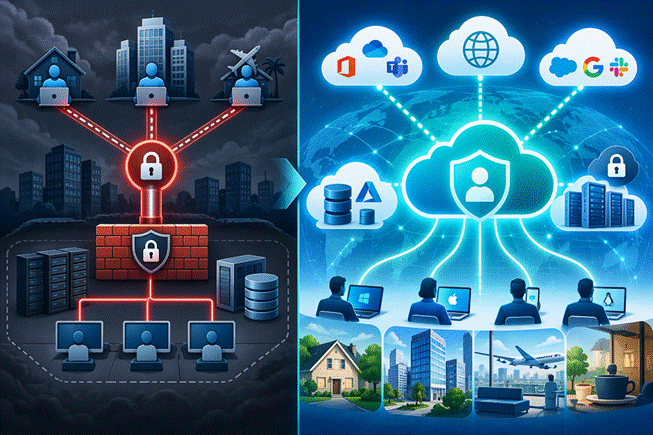
From perimeter-centric connectivity to identity-aware, cloud-delivered access.
What Microsoft Global Secure Access Includes
Microsoft Entra Internet Access
Entra Internet Access is Microsoft’s identity-centric secure web gateway capability for internet, SaaS, AI application, and Microsoft service traffic. Microsoft documents capabilities that include traffic acquisition from endpoint clients and remote networks, detailed traffic logs, web content filtering, threat intelligence filtering, and Transport Layer Security inspection.
- Apply identity and Conditional Access context to network traffic.
- Protect access to Microsoft 365, SaaS applications, AI services, and the public internet.
- Provide user-aware logging and policy visibility.
- Block malicious or disallowed destinations using security and content policies.
Microsoft Entra Private Access
Entra Private Access is Microsoft’s Zero Trust Network Access capability for private applications and resources hosted on-premises or across clouds. It is designed to replace broad network-level VPN access with more granular, application-specific access.
- Publish private applications without exposing an entire internal network.
- Use Conditional Access, multifactor authentication, device compliance, and risk signals.
- Support legacy and modern private resources through identity-aware controls.
- Reduce opportunities for lateral movement through per-application segmentation.
Three Traffic Profiles
| Traffic profile | Primary purpose |
| Microsoft traffic | Microsoft Entra ID, Microsoft Graph, Exchange Online, SharePoint Online, and other Microsoft services. |
| Private access | Traffic destined for private corporate applications and resources. |
| Internet access | Public internet, non-Microsoft SaaS applications, and other web destinations. |
Business and Security Benefits
| Identity and network convergence | Extends identity context into network access decisions, reducing gaps between authentication policy and traffic enforcement. |
| VPN modernization | Replaces broad, network-level access with application-specific Zero Trust access for private resources. |
| Microsoft 365 alignment | Provides dedicated handling and visibility for Microsoft traffic and supports Conditional Access integration. |
| Unified administration | Consolidates key access policies in the Microsoft Entra ecosystem, which can reduce operational fragmentation for Microsoft-centric environments. |
| Improved user experience | Uses cloud edge connectivity and application-aware routing instead of requiring users to manually establish a traditional VPN session for every private resource. |
| Better investigation context | User-aware traffic logs and identity signals can improve correlation across access, endpoint, and security operations workflows. |
Can It Replace Zscaler and GlobalProtect?
| Short answer Potentially, yes, but not as a blanket one-for-one claim. Global Secure Access can address many secure web gateway, Zero Trust Network Access, and remote-access scenarios. The correct decision depends on required security functions, geographic coverage, application protocols, branch architecture, compliance obligations, operational maturity, and licensing. |
Replacement positioning
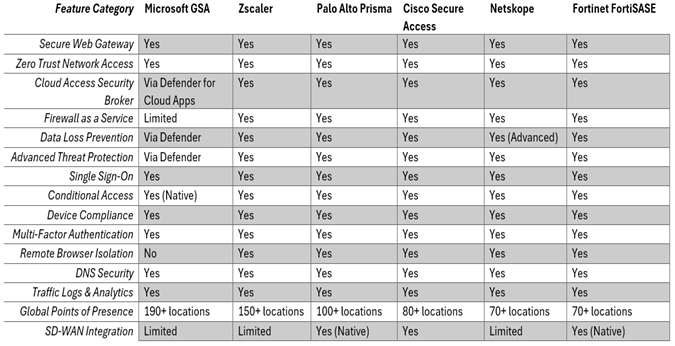

A unified operating model can connect identity, endpoint, network, cloud application, and security operations signals.
Where GSA May Be Especially Compelling
- The organization is standardized on Microsoft Entra ID, Microsoft Intune, Microsoft Defender, Microsoft Sentinel, and Microsoft 365.
- Security leadership wants to converge identity and network access policy.
- The organization is retiring traditional VPN access in favor of application-specific ZTNA.
- Microsoft 365 performance, Conditional Access integration, and simplified administration are strategic priorities.
- Vendor consolidation is a business objective, provided security and operational requirements remain satisfied.
Where a Careful Gap Assessment Is Essential
- Advanced secure web gateway, data loss prevention, browser isolation, sandboxing, or specialized inspection requirements.
- Non-Windows endpoint support and unmanaged-device scenarios.
- Branch and remote-network architecture, including IPsec connectivity and egress controls.
- Private application protocols, overlapping IP address spaces, DNS dependencies, and legacy authentication.
- Data residency, sovereign cloud, regulated-industry, or government-environment requirements.
- Existing integrations with third-party firewalls, SIEM platforms, ticketing systems, and security operations processes.
Recommended Migration Approach
| 1. Discover | Inventory users, devices, branches, internet destinations, SaaS services, private applications, protocols, authentication methods, and current Zscaler or GlobalProtect policy dependencies. |
| 2. Define success criteria | Set measurable goals for security control coverage, user experience, policy equivalence, performance, availability, logging, compliance, and support operations. |
| 3. Run a proof of concept | Pilot Microsoft traffic, private access, and internet access scenarios with representative users, locations, devices, applications, and failure conditions. |
| 4. Validate coexistence | Use controlled traffic steering and phased user groups to avoid disrupting production access while comparing policy results and telemetry. |
| 5. Migrate in waves | Move lower-risk applications and user groups first, then expand to complex private applications, branches, and internet traffic. |
| 6. Retire legacy services | Decommission licenses, appliances, tunnels, policies, and operational procedures only after coverage and rollback criteria have been validated. |
Executive Decision Checklist
- ☐ Does the solution meet required SWG, ZTNA, TLS inspection, logging, and threat protection capabilities?
- ☐ Can all critical private applications and protocols be supported without expanding network-level trust?
- ☐ Are Conditional Access, device compliance, and risk-based policies designed and tested?
- ☐ Is regional edge coverage and user experience acceptable for every operating location?
- ☐ Can security telemetry be retained, monitored, and integrated with incident response processes?
- ☐ Are licensing, migration, coexistence, training, and support costs understood?
- ☐ Is there a tested rollback plan for each migration wave?
Conclusion
Microsoft Global Secure Access represents a shift from network-centric remote access toward identity-centric, continuously evaluated access. For organizations invested in the Microsoft security ecosystem, it can become a strategic platform for protecting Microsoft services, internet and SaaS traffic, and private applications while reducing reliance on traditional VPN infrastructure.
It should be presented as a credible alternative to Zscaler, Palo Alto Global Protect, etc.
References
- Microsoft Learn: What is Global Secure Access?
- Microsoft Learn: Global Secure Access deployment guide
- Microsoft Security: Microsoft Entra Internet Access
- Microsoft Security: Microsoft Entra Private Access
- Microsoft Inside Track: Transforming our VPN with Global Secure Access
Regards,
Prabhat Nigam | Global CTO at Golden Five Consulting.
GOLDEN FIVE | CYBERSECURITY INSIGHTS
